SeeBot
A project for developing a smart aid to support people with vision loss to travel on their own.
Getting to know SeeBot
SeeBot is an idea that I studied for my master’s thesis in human-computer interaction (HCI). It’s designed for people with visual impairment and blindness to navigate in outdoor environments. Together with white canes, SeeBot wants to help people find the way, stay away from moving objects, and avoid accidents.
Note: Due to research limitations, I wasn’t able to study the idea for people with both vision and hearing loss.
What people need for wayfinding
People want to find their way safely and independently.
To do that, they need to:
- Keep their ear canals open so that they can identify and orient using noise in the surroundings. For example, beeping sound of a traffic light.
- Predict near and far space for decision-making in wayfinding.
What is a white cane
There are different types of white canes for different needs. Most common needs are navigation and object detection, for which long white cane and folding cane are often used.
A long white cane generally has a length of 115 to 165 cm, while a folding cane is 70 to 135 cm long. Due to its length, a folding cane is easier to bring when travelling.
How to use a white cane
A white cane is usually used in two main aspects:
- Grip used to hold the white cane, especially when a person’s pace is faster and more regular in outdoor environment:
- The palm facing up at waist height with the index finger pointing along the cane
- The remaining fingers and thumb wrapping around the cane lightly
-
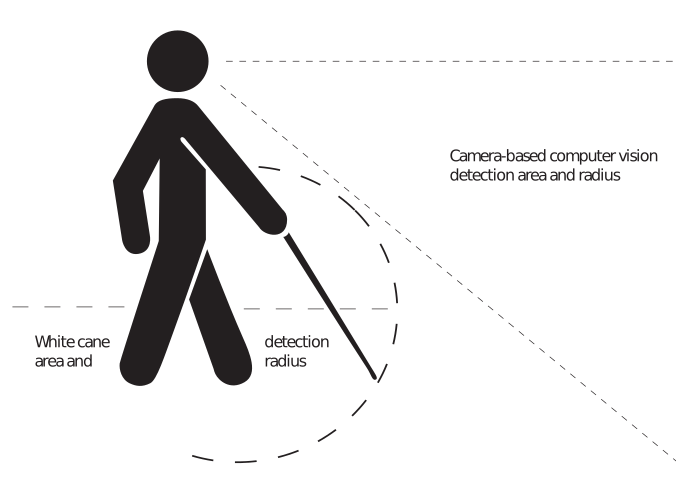
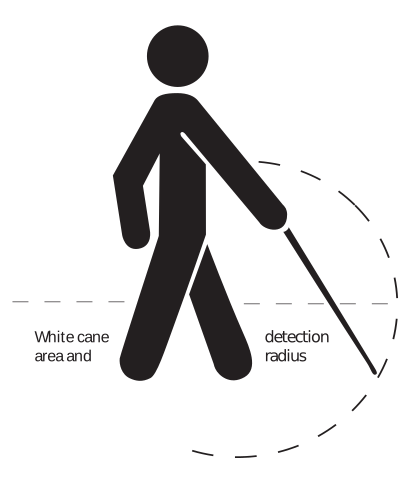
Arc makes of a radius for near-space navigation.
Limitation of a white cane
Due to its nature, a white cane is good at near-space and below-knee detection.
However, it’s not able to help detect in far-space and above-knee space. Consequently, people can get injured by static objects like tree branches and moving objects like cyclists.
What SeeBot can do
SeeBot uses computer vision with machine learning to provide detection of surrounding environments. It is intended to give preview of the surroundings to people for decision-making in wayfinding, together with the use of white canes.
Note: It will be investigated whether real-time preview is more helpful and critical for wayfinding.